Best AI Powered Glasses Manufacturers in China?

Choosing the best manufacturers of Ai-Powered Glasses in China takes more than comparing product photos or factory prices. Buyers need to examine optical clarity, frame weight, battery life, microphone performance, and heat during extended use. Small details matter. A frame that feels comfortable for ten minutes may press against the nose after an hour. Ask for working samples, test them in ordinary indoor and outdoor settings, and review how suppliers handle quality checks, customization, and after-sales support.

Meta CEO Mark Zuckerberg has described the appeal of the format this way: “I think that the glasses are going to be the ideal form factor for AI, because they let you let an AI see what you see and hear what you hear.” That vision is useful, but it does not prove that every product is ready for daily use. A capable supplier should explain which features run on the glasses, which rely on a connected phone, and what happens when connectivity drops. Request clear specifications and documentation, then compare those claims against real tests. No shortlist is perfect. Manufacturing capability can look strong on paper while fit, software stability, or service falls short. This guide introduces Chinese manufacturers and the practical questions buyers should ask before choosing a partner.
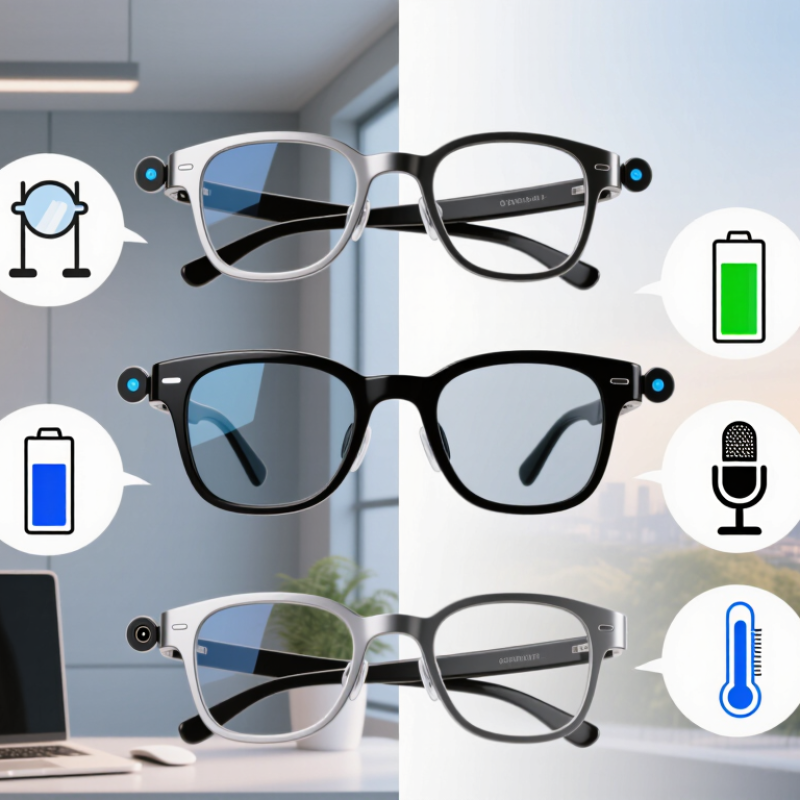
Best AI Powered Glasses Manufacturers in China?

Understanding AI-Powered Glasses and Their Key Features

AI-powered glasses combine a lightweight frame, miniature cameras or sensors, microphones, speakers, and computing software. Their AI features may describe nearby objects, answer spoken questions, translate short phrases, or capture hands-free notes. Capabilities vary widely, so “AI-powered” alone says little about real-world performance.

Pay attention to the interaction details. A clear microphone should pick up speech in a quiet room without forcing the wearer to repeat every sentence. Open-ear speakers can provide directions while keeping surrounding sounds audible. A small camera may support visual questions, but results depend on lighting, distance, and the angle of view. Battery life also matters: continuous audio or image processing can drain a compact frame faster than occasional use. Comfort is measurable, too. Check the weight, nose-pad pressure, heat near the temples, and whether the controls work without looking.

Privacy and reliability deserve equal attention. Find out whether processing happens on the glasses, a paired phone, or a remote server, and what data is stored. Test key functions in ordinary settings before relying on them; recognition can fail with glare, background noise, or unfamiliar accents. That is a real limitation, not a minor footnote. Specifications may look impressive, yet everyday usability can still feel uneven.

China’s AI-Powered Glasses Manufacturing Landscape

China’s AI-powered glasses manufacturing landscape draws on a dense network of optical, electronics, and assembly suppliers. In areas such as Shenzhen and Dongguan, factories can source frame components, miniature speakers, batteries, and camera modules within short supply chains. This proximity can speed up prototyping and production changes. It does not guarantee quality.

The market is expanding. Counterpoint Research reported that global smart-glasses shipments rose 210% year over year in the second quarter of 2024, with audio-focused models contributing to growth. Grand View Research estimated the global smart-glasses market at US$1.93 billion in 2023 and projected a 27.3% compound annual growth rate from 2024 to 2030. These figures describe different measures, so they should not be treated as directly comparable. For buyers assessing Chinese manufacturers, practical checks matter: hinge durability, optical alignment, microphone performance, heat management, and battery life during continuous use. Ask for test methods and sample results, not just production-capacity claims. Some specifications look impressive on paper. Real-world comfort remains harder to measure.

Leading AI-Powered Glasses Manufacturers in China

China’s leading AI-powered glasses manufacturers are building products that combine lightweight frames, cameras, microphones, speakers, and compact computing modules. Their strengths often include rapid prototyping and access to mature electronics supply chains. A sample frame can move from CAD design to a wearable prototype quickly. Small details matter: hinge resistance, nose-pad pressure, microphone placement, and heat near the temples. Comfort is not a minor feature.

Manufacturers differ in optical expertise, software integration, and testing depth. Buyers should ask how each supplier checks battery performance, audio clarity, camera consistency, and frame durability. Request measurable specifications, sample units, and clear records of quality inspections. Ask who develops the companion app and how firmware updates are handled. Details reveal much. A polished demo is useful, but it cannot replace weeks of wear testing. Some product claims may also sound more certain than real-world performance; indoor lighting, wind, and background noise can affect results. That deserves scrutiny. Strong manufacturing partnerships depend on transparent communication, realistic timelines, and willingness to revise uncomfortable or unreliable designs. A low prototype cost can be attractive, yet tooling changes and software support may alter the final budget.

AI-Powered Glasses in China: Bluetooth LE Data Rates

Bluetooth LE physical-layer options provide a useful connectivity benchmark when evaluating smart-glasses designs and manufacturers.

Rates shown are theoretical PHY data rates from the Bluetooth LE specification, not application-level throughput. Actual performance depends on connection conditions, device implementation, and protocol overhead.

How to Compare Manufacturers, Technologies, and Product Quality

When comparing AI-powered glasses manufacturers in China, look beyond a polished sample. Ask who designs the optical module, assembles the frame, and writes the companion software. Some suppliers handle everything; others coordinate several subcontractors. That difference can affect revisions and delivery schedules. Ask for a component list and a clear account of each production step.

Test the glasses in ordinary conditions. Read a screen near a window, record a voice note beside a quiet fan, and check whether the frames feel warm after a short call. Review microphone pickup, speaker leakage, camera stability, battery life, and the weight distribution across the nose. Small details matter. A feature sheet cannot prove comfort.

Request samples from more than one production batch, plus inspection records and relevant test reports. Check how the manufacturer handles defects and replacement parts. I still find hinge durability easy to overlook. A neat prototype may use better components than a later shipment, so ask how sample specifications match the final bill of materials.

Also clarify firmware updates and who supports them after delivery. Be specific. A vague answer is not evidence of poor quality, but it deserves follow-up.

How to Evaluate and Select a Chinese AI Glasses Manufacturer

A 2025 Counterpoint Research report said global smart-glasses shipments rose 210% year over year in the first half of 2025. That growth signals interest, not product quality. The category includes devices with different levels of AI capability. Ask suppliers what their figures measure. Request evidence, not market-size claims.

Review the optical design, microphone placement, camera alignment, battery capacity, and thermal management. Request a bill of materials, component traceability, and pilot-run yield data. Test voice pickup beside traffic noise. Check device temperature after 30 minutes of continuous use. Ask how firmware updates and failures are tested. Short answers matter.

A factory tour can be staged. A polished demo proves little. Review quality-system records, calibration logs, and reliability-test conditions. Check whether test samples represent the production model. Confirm tooling ownership, engineering-change procedures, minimum order quantities, and repair arrangements in writing. Counterpoint’s shipment figure covers a broader smart-glasses category, so it is not a forecast for AI glasses. This is easy to overlook when suppliers present fast-growing market charts.