Top Prison LED Downlights for Global Buyers
A Prison LED Downlight must do more than brighten a room. It needs to deliver consistent illumination, resist frequent use, and remain straightforward to inspect and maintain. For global buyers, small details matter: the trim’s fit, the diffuser’s cleaning requirements, and how evenly light reaches a corridor or shared room. A product photo rarely reveals these differences.
Lighting researcher Dr. Mariana Figueiro studies how light affects human rhythms. A practical paraphrase of her work is: “Light is a powerful signal for the body’s daily rhythms.” That perspective encourages buyers to consider color temperature, glare, and nighttime lighting—not just wattage. This guide compares downlight features, materials, efficiency, and installation needs, while recognizing that facility conditions vary. Specifications still need careful checking.
There is no universal best model. A robust housing may be worthwhile, yet its value depends on the environment and maintenance plan. Some product descriptions also leave important details unclear. That deserves scrutiny. The goal is to help procurement teams ask better questions and compare products using verifiable specifications, rather than promises alone.
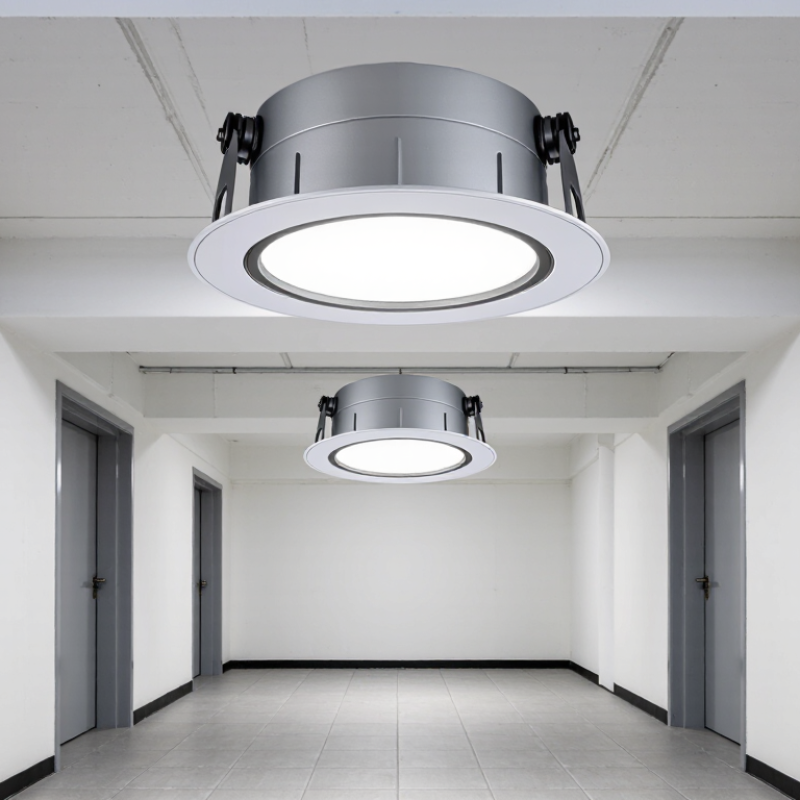
What Prison LED Downlights Are and Where They Are Used
Prison LED downlights are ceiling fixtures designed for controlled, demanding indoor environments. They may be recessed or surface-mounted, depending on the ceiling and maintenance plan. Many use impact-resistant housings, protected lenses, and secure fastenings. These features help limit damage and reduce access to fixture parts. They also support consistent lighting with lower energy use than many older lamps. Not just brighter. Light distribution matters.
These fixtures may serve cells, corridors, dayrooms, dining areas, and staff workspaces. Each space has different needs. Cells need even light without harsh glare across beds or desks. Corridors benefit from steady illumination that helps staff see thresholds and doorways. In dayrooms, broad, comfortable light can support reading and routine activities. Fixture selection should account for ceiling height, cleaning methods, ventilation, and the facility’s technical requirements. One detail is easy to miss: a high-output fitting can still leave dark patches if spacing is poorly planned.
Tips: Check the lens, mounting, and stated impact rating before specifying a fitting. Compare light distribution, not only wattage. Ask a qualified lighting professional to review a sample layout; real ceilings rarely match the drawing perfectly.
| Topic or Location | What It Means | Typical Lighting Considerations | Features to Check |
|---|---|---|---|
| What a prison LED downlight is | A recessed or surface-mounted ceiling luminaire that directs light downward. LED describes its light source; “prison” describes the demanding application, not a single standardized product category. | Fixtures are selected for the room, ceiling construction, operating conditions, maintenance access, and applicable local requirements. | Confirm mounting method, dimensions, driver arrangement, photometric data, and compatibility with the ceiling and electrical system. |
| Cells and sleeping areas | Individual accommodation spaces where general lighting may be combined with separate reading or night-lighting functions. | Consider uniform illumination, glare control, cleanable surfaces, and lighting controls suited to the facility’s operating procedures. | Review lens and trim security, tamper-resistant fixings, impact resistance, and whether the fixture can be serviced from the required side. |
| Corridors and circulation routes | Internal routes connecting accommodation, service, and shared spaces. | Even light distribution can help reduce dark areas and support routine observation and movement. | Check spacing and photometric calculations, glare, mounting height, durability, and whether emergency lighting is required by local code. |
| Bathrooms and wash areas | Wet or frequently cleaned spaces within accommodation or shared facilities. | Moisture exposure and cleaning methods influence the required enclosure and materials. | Choose an ingress-protection rating suitable for the actual exposure and installation location. IP65 is dust-tight and protected against water jets; it does not by itself establish suitability for every wet-area installation. |
| Dayrooms and shared areas | Common spaces used for supervised activities, dining, or recreation. | Balance general illumination with visual comfort and the room’s tasks; avoid relying on wattage alone to predict light levels. | Compare lumen output, beam distribution, glare information, color rendering, and lighting calculations for the room layout. |
| Interview and examination rooms | Rooms used for conversations, assessments, or other visually demanding tasks. | Consistent, comfortable lighting can support face-to-face tasks and clear visibility. | Review color rendering, color temperature, dimming requirements, glare control, and the specified illuminance for the task. |
| Secure or high-impact locations | Areas where fixtures may be exposed to deliberate tampering or physical impact. | Security needs depend on the facility’s risk assessment and the specific installation. | Check documented impact-test ratings and construction details. IK ratings use standardized impact-energy tests; IK10 corresponds to 20 joules, but a rating alone does not guarantee resistance to every form of attack. |
| Emergency and backup lighting | Lighting intended to operate when normal power is interrupted, where required by the project. | Emergency lighting design, duration, coverage, testing, and signage requirements vary by jurisdiction and building use. | Verify applicable local regulations, emergency-system compatibility, test provisions, and project-specific certification before specifying a product. |
| Global buyer checks | Procurement checks that help compare products across markets and projects. | Electrical supply, installation practices, environmental conditions, and compliance requirements differ between destinations. | Confirm input voltage and frequency, local product approvals, installation dimensions, maintenance access, warranty terms, spare-parts availability, and photometric files. |
Security and Durability Requirements in Correctional Facilities
Top Prison LED Downlights for Global Buyers
Correctional facilities demand clear, even light and fixtures that withstand frequent cleaning and daily wear. Security starts with construction. Flush housings, protected lenses, and captive fasteners reduce exposed edges and discourage casual interference. Yet no fixture is tamper-proof; claims like that deserve scrutiny. Buyers should check impact-test reports, ingress protection, and material compatibility with the site’s cleaning agents. Look closely. Light distribution matters too: harsh glare can make observation harder, while dark corners complicate routine checks. Specify photometric data for the actual mounting height, not just a broad lumen figure.
Durability depends on heat management, driver quality, and stable output over years of long operating hours. Ask for documented lifetime assumptions and test conditions; a headline lifespan without them says little. Smooth, corrosion-resistant surfaces are easier to wipe, but finishes still need evaluation against local cleaners. Plan service access with facility staff so maintenance can happen predictably without compromising fixture security. That balance is rarely perfect. Some facilities may prioritize ruggedness and accept less convenient servicing; make that trade-off explicit. Before purchase, compare independent test evidence, warranty terms, replacement-part availability, and local installation conditions. Specifications vary by project.
Key Lighting Specifications for Prison Downlights
Prison downlights must deliver even illumination without creating dark patches around doors, bunks, or desk surfaces. Specify maintained light output, beam angle, glare control, and color rendering together; a high lumen rating alone says little about usable visibility. A flush, impact-resistant face and secured housing also reduce damage risks in demanding spaces. Details matter.
ENERGY STAR’s Residential Downlight Specification sets a 55 lumens-per-watt efficacy threshold and a minimum color rendering index of 80. These figures offer a useful efficiency and color-quality reference, not a detention-specific requirement. The U.S. Department of Energy’s 2022 Solid-State Lighting R&D Opportunities report identifies efficacy, thermal management, and reliability as continuing LED development priorities. For facility buyers, driver temperature and accessible replacement parts deserve as much scrutiny as advertised output.
Choose a color temperature suited to the space, commonly within a neutral-white range, then assess samples under actual ceiling height and surface finishes. Confirm that dimming does not cause flicker, and check photometric files for spacing and uniformity. A long rated life can still disappoint if heat builds up above a sealed ceiling. Review maintenance access and test emergency-circuit compatibility before ordering; these details are easy to overlook.
Top Prison LED Downlights for Global Buyers — Key Lighting Specifications
Ingress protection is an important specification when selecting downlights for demanding environments. The chart compares the dust and water protection digits of common IP ratings under IEC 60529.
A higher digit indicates a higher protection level within that test category: IP5X is dust-protected, IP6X is dust-tight; IPX4 protects against splashing water, IPX5 against water jets, and IPX6 against powerful water jets. IP ratings do not measure impact resistance or vandal resistance, which should be specified separately.
Types of Prison LED Downlights and Their Features
Prison LED downlights commonly include recessed sealed units, surface-mounted units, and emergency models with battery backup. Sealed recessed fixtures sit close to the ceiling and can reduce exposed edges. Specify impact-resistant lenses, secure trims, and smooth, cleanable surfaces. Check the stated IK impact rating and IP ingress rating against the room’s actual conditions; a rating alone does not prove a fixture is suitable.
Surface-mounted downlights can simplify replacement where ceiling voids are shallow. Their housings should resist impact and avoid loose external parts. Emergency versions add battery backup and a clear test indicator, but runtime and testing requirements vary by project. Small details matter. Glare matters too. A harsh beam can make a secure corridor uncomfortable, so review beam angle, color temperature, and measured illuminance together.
The U.S. Department of Energy’s 2020 U.S. Lighting Market Characterization reported that LEDs made up about 48% of installed lighting stock. That indicates wide adoption, not automatic suitability for every facility. For procurement, compare photometric files, warranty terms, driver access, and replacement procedures. Ask for documentation, not just a sales claim. I would also verify the proposed fixture in a sample room; drawings rarely capture how a lens looks at eye level.
How Global Buyers Evaluate Suppliers and Compliance
Global buyers should evaluate prison LED downlights through test evidence, not catalog claims alone. The U.S. Department of Energy’s Energy Saver guidance reports that LEDs use at least 75% less energy and last up to 25 times longer than incandescent lighting. Those figures offer useful context, but they do not predict performance in a confined, high-use space. Request an independent LM-79 photometric report showing delivered lumens, efficacy, beam spread, and color consistency. Check LM-80 data and TM-21 lifetime projections, too. A rated life is a projection, not a guarantee.
Compliance depends on the destination market. Ask suppliers to identify the applicable electrical safety and photobiological standards, then verify certificates with the issuing test body. Review ingress-protection ratings, operating-temperature limits, surge protection, and evidence of impact-resistant construction. A sealed housing may reduce dust entry, but can also complicate heat management. That trade-off deserves scrutiny. The IEA’s Energy Efficiency 2023 report recorded a 2.2% improvement in global energy intensity in 2022; efficient lighting can support that broader effort, but procurement decisions still need product-level evidence. Compare warranty terms, spare-part availability, and replacement procedures alongside price. A polished compliance file is helpful, yet one missing test scope can change what the certificate actually covers.