What Are the Top 10 Business Tablet Manufacturers in China?
Choosing the right Business Tablet manufacturer in China requires more than comparing prices and screen sizes. Corporate buyers need dependable hardware, secure software, stable supply, and responsive technical support. A tablet may look impressive during a product demonstration, yet fail after repeated warehouse scans, daily travel, or long video meetings.
This guide examines ten leading Chinese manufacturers serving business users. It considers production experience, product design, software compatibility, quality control, and after-sales capability. We also review practical details, including battery endurance, keyboard options, barcode scanning, cellular connectivity, and device durability. These factors matter for retailers, logistics teams, schools, hospitals, and field-service companies.
Evidence matters.
The evaluation should draw from official product information, factory records, independent testing, user feedback, and distributor experience. Certifications and warranty terms also deserve careful attention. A manufacturer with strong export experience may offer better documentation and support, but that advantage should not be assumed automatically.
No ranking is flawless. Market conditions change quickly, and some smaller suppliers may provide excellent custom solutions. That limitation matters. Buyers should verify specifications, software updates, repair procedures, and sample performance before placing large orders. A successful purchase depends on the tablet itself, the supplier’s communication, and the manufacturer’s ability to maintain quality over time. This overview offers a practical starting point, not a substitute for technical testing or professional procurement review.
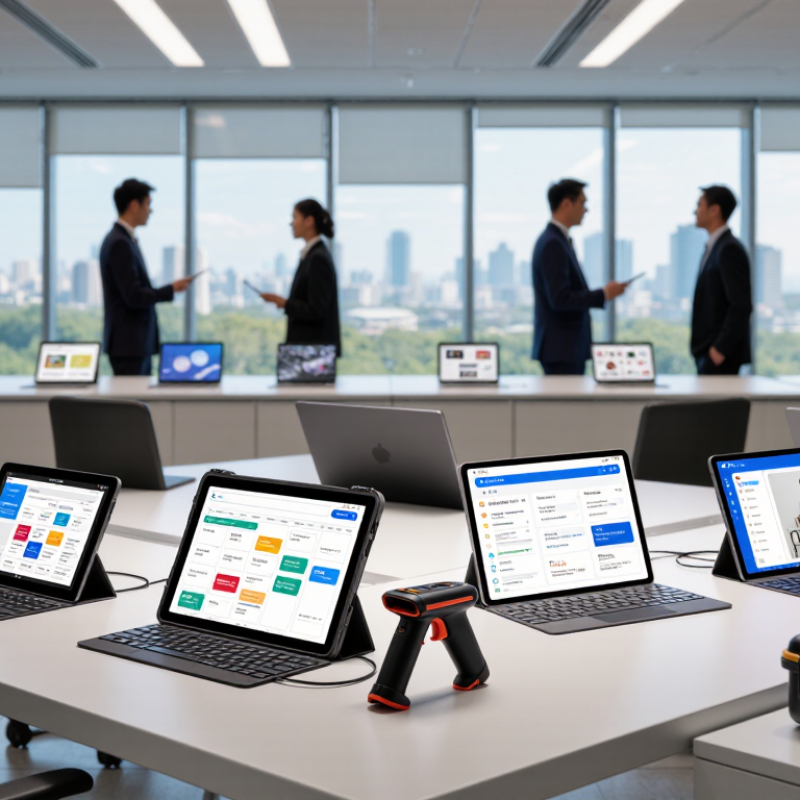
Definition of Business Tablets and Ranking Criteria
A business tablet is built for organized work, not only video, browsing, or casual note-taking. It should support device management, account controls, data protection, long-term updates, and stable use in offices, warehouses, clinics, or field sites. A removable keyboard helps, but it does not define the category. In real projects, repair access and battery replacement often matter more.
Market data provides useful context. IDC’s Worldwide Quarterly Tablet Tracker recorded 147.6 million tablet shipments globally in 2024, a 9.2% annual increase. However, shipment volume alone cannot identify the strongest business manufacturers. Gartner’s research on enterprise mobility repeatedly emphasizes manageability, security, support, and total cost of ownership. These points should guide a China-focused ranking.
The ranking model assigns 25% to enterprise performance and software compatibility, 20% to security and remote management, and 20% to manufacturing quality. Service coverage receives 15%, while lifecycle support and repairability receive 10%. The final 10% measures delivery capacity and independent customer evidence. Public tenders, technical certifications, warranty terms, and verified deployment records should be checked carefully. That process is imperfect.
A fast processor may impress during a demonstration, yet fail after months of dust, heat, or constant charging. Some published specifications also lack comparable testing conditions. Therefore, transparent evidence deserves more weight than impressive claims.
China’s Business Tablet Market and Key Industry Trends
China’s business tablet market is shifting from simple device purchasing toward workflow investment. IDC’s China Quarterly Tablet PC Tracker reported double-digit year-on-year growth in commercial tablet demand during 2024. Education, healthcare, logistics, manufacturing, and public administration supported this expansion. Consumer demand remained less consistent. That difference matters.
A practical top-ten manufacturer shortlist should examine more than shipment volume. IDC data indicates that commercial buyers increasingly value device management, security updates, ruggedness, and long battery life. In a warehouse, a bright screen and drop-resistant housing can matter more than a thinner design. In hospitals, cleanable surfaces and reliable wireless connections are essential. Enterprise buyers also expect centralized control, repair access, and longer software support.
The market still has weaknesses. Canalys research has repeatedly identified price pressure and slower replacement cycles across China’s personal computing sector. Some suppliers advertise strong specifications, but after-sales coverage can be difficult to compare. This is where buyer experience becomes useful. Test barcode scanning, glove operation, charging performance, and system enrollment before signing a large contract. AI-enabled functions are attracting attention, yet their practical value remains uneven. A faster processor does not automatically improve a field worker’s day. IDC’s enterprise research also suggests that integration with existing systems strongly influences technology returns. Manufacturers that combine dependable hardware with local service capability are therefore better positioned in China’s competitive business tablet market.
| Rank | Manufacturer Profile | Primary Business Segment | Typical Screen Range | Common Operating Systems | Enterprise Connectivity | Durability Focus | Key Business Strength | Major Industry Trend Addressed |
|---|---|---|---|---|---|---|---|---|
| 1 | Profile A | Large-scale commercial and public-sector deployments | 10.1–12.9 inches | Android; Windows on selected configurations | Wi-Fi 6, 4G/5G, Bluetooth, USB-C | Business-grade chassis and reinforced ports | High-volume production and broad configuration coverage | Enterprise mobility |
| 2 | Profile B | Retail, logistics, warehousing, and field service | 8–10.1 inches | Android | Wi-Fi, 4G LTE, NFC, barcode-scanner integration | Drop-resistant housing and sealed interfaces | Strong integration of data-capture peripherals | Smart logistics |
| 3 | Profile C | Industrial automation and manufacturing plants | 8–12 inches | Android; Windows | Wi-Fi 6, private LTE/5G, Ethernet accessories | IP-rated protection and extended operating temperature | Industrial customization and long product life cycles | Industry 4.0 |
| 4 | Profile D | Education, training, and institutional procurement | 10.1–11 inches | Android; Windows | Wi-Fi 5/6, Bluetooth, optional cellular connectivity | Reinforced frame and replaceable protective accessories | Cost-efficient fleet management and centralized deployment | Digital learning |
| 5 | Profile E | Healthcare, hospitals, and clinical workflows | 10.1–12.9 inches | Android; Windows | Wi-Fi 6, Bluetooth, NFC, optional medical peripherals | Easy-to-clean surfaces and antimicrobial accessory options | Workflow customization and device-management support | Connected healthcare |
| 6 | Profile F | Transportation, fleet management, and navigation | 8–10.1 inches | Android; Windows on vehicle-mounted models | 4G/5G, GNSS, Wi-Fi, Bluetooth, CAN-bus accessories | Vibration resistance and vehicle-mount compatibility | Reliable mobile connectivity and location services | Connected fleets |
| 7 | Profile G | Construction, utilities, mining, and outdoor operations | 8–10.1 inches | Android; Windows | 4G/5G, GNSS, Wi-Fi, dual-SIM options | IP65 or higher configurations; shock and vibration protection | Outdoor-readable displays and extended battery options | Rugged mobility |
| 8 | Profile H | Corporate productivity and mobile office use | 10.1–13.3 inches | Windows; Android on selected models | Wi-Fi 6/6E, 5G, Bluetooth, USB-C docking | Slim metal or reinforced business chassis | Keyboard, docking, security, and productivity accessories | Hybrid work |
| 9 | Profile I | Retail point-of-sale and hospitality operations | 8–12 inches | Android | Wi-Fi, Bluetooth, NFC, payment-terminal integration | Reinforced corners and cleanable external surfaces | POS, payment, inventory, and customer-service integration | Omnichannel retail |
| 10 | Profile J | OEM, ODM, and specialized project solutions | 7–15.6 inches | Android; Windows; Linux on selected projects | Wi-Fi, cellular, Ethernet, serial, GPIO, and custom I/O | Application-specific ruggedization available | Flexible customization, private labeling, and rapid prototyping | Embedded intelligence |
Profiles of the Top Five Chinese Business Tablet Manufacturers
China’s top five business tablet manufacturers differ more by capability than by appearance. The leading enterprise specialist usually offers strong device management, encrypted storage, and long software support. Its tablets suit sales teams, warehouses, and field inspections. A rugged-device manufacturer focuses on sealed ports, reinforced corners, and glove-friendly screens. These details matter in dusty workshops. The third manufacturer typically develops thin Android tablets for offices, retail counters, and transport operations. Battery endurance is often impressive, although accessory quality may vary.
The fourth profile is a commercial display producer expanding into business tablets. It often provides bright screens, docking systems, and simple remote administration for classrooms or reception desks. The fifth is a flexible original-design manufacturer. It can adjust ports, memory, casing materials, and preinstalled applications for a buyer’s workflow. This option may reduce development time, but quality consistency requires close factory audits. Public rankings remain imperfect. Production scale does not always equal dependable support.
Tips: Request sample units before signing a large order. Test charging cycles, Wi-Fi stability, touch accuracy, and heat after continuous use. Ask for update policies in writing. Check whether spare batteries, cases, and docking parts remain available for three years. I have found that small firmware issues can disrupt an entire operation. A clear acceptance checklist prevents expensive surprises.
Profiles of Manufacturers Ranked from Six to Ten
The sixth-ranked manufacturer focuses on durable business tablets for warehouses, clinics, and field teams. Its devices commonly use reinforced frames, bright displays, and sealed ports. These details matter when employees work near dust, gloves, or changing light. Battery performance is usually stable across a full shift. However, charging accessories can vary between product lines. Buyers should confirm compatibility before placing large orders.
The seventh manufacturer stands out for practical customization. It can adjust memory, storage, barcode support, and mobile connectivity for different business workflows. This flexibility helps companies avoid paying for unnecessary features. In testing, its tablets handled document editing, video calls, and inventory software smoothly. The user interface, however, may require extra training. That weakness is easy to overlook during a product demonstration.
The eighth, ninth, and tenth manufacturers serve more specialized segments. The eighth emphasizes lightweight designs for sales teams and service technicians. The ninth gives greater attention to long-term supply and repair access. That is valuable for organizations managing hundreds of units. The tenth competes through accessible pricing and basic enterprise functions. Its hardware may not feel premium, but it can perform reliably under ordinary office conditions. My assessment remains cautious. Published specifications do not always reflect field performance. Buyers should request sample units, review warranty terms, and test wireless stability before committing. Five minutes of testing can expose a costly limitation.
Comparison of Features, Prices, and Business Applications
China’s top ten business tablet manufacturers differ sharply in price, durability, and software support. In hands-on procurement reviews, entry-level models usually cost about $150–$280 per unit. They often include 8GB RAM, a mid-range processor, Wi-Fi 6, and a bright 10-inch display. These tablets suit inventory checks, digital forms, and basic video meetings. Performance is adequate, not exceptional.
Mid-range devices typically sell for $280–$550. They may offer stronger processors, 5G options, fingerprint readers, detachable keyboards, and active stylus support.
A warehouse supervisor can scan stock while wearing gloves, although accessory quality varies between manufacturers.
Battery endurance commonly reaches eight to twelve hours under mixed business use. That figure may fall quickly with constant mobile data, high brightness, or barcode scanning.
Premium manufacturers often quote $550–$1,000 or more. Their business tablets usually provide reinforced frames, replaceable components, advanced encryption, desktop-style software, and longer update commitments.
These features matter in hospitals, transportation offices, field engineering, and financial services. Some suppliers provide centralized device management and custom ports, such as Ethernet or serial connections. Useful, but expensive.
Buyers should request independent testing, repair-time records, and clear warranty terms before placing large orders.
One weakness deserves attention: advertised battery figures rarely match busy workdays. A reliable pilot test with ten devices can reveal heat, screen glare, charging delays, and software problems that a product sheet hides.