Who Are the Top 10 Tile Display Rack Suppliers in China?
Choosing a Tile Display Rack Supplier in China can shape how customers see a collection and how safely samples are handled. A strong rack should do more than look polished. It needs to hold heavy porcelain slabs or compact samples, allow easy comparison, and fit the store’s floor plan. Details matter. This guide introduces ten suppliers to consider, focusing on product range, customization, materials, and communication. Some offer rotating towers for small formats; others build pull-out panels, A-frame stands, or wall-mounted boards. The right design depends on tile size, display frequency, and available space.
We assess suppliers through practical questions: Can they share clear specifications, finish options, sample photos, and packing details? Do they explain load limits and lead times? Can they adapt branding or dimensions without making maintenance difficult? A reliable Tile Display Rack Supplier should answer these points plainly and provide consistent updates during sampling and production. Still, a list cannot replace direct checks. Capabilities change, and a polished catalog may not show how a rack performs after months of use. Ask for recent project references, confirm measurements, and review a sample when possible. Not every supplier fits. The profiles below are a starting point, not a final verdict; compare quotes, build quality, service, and delivery needs.
How Tile Display Racks Are Used in Retail and Showrooms
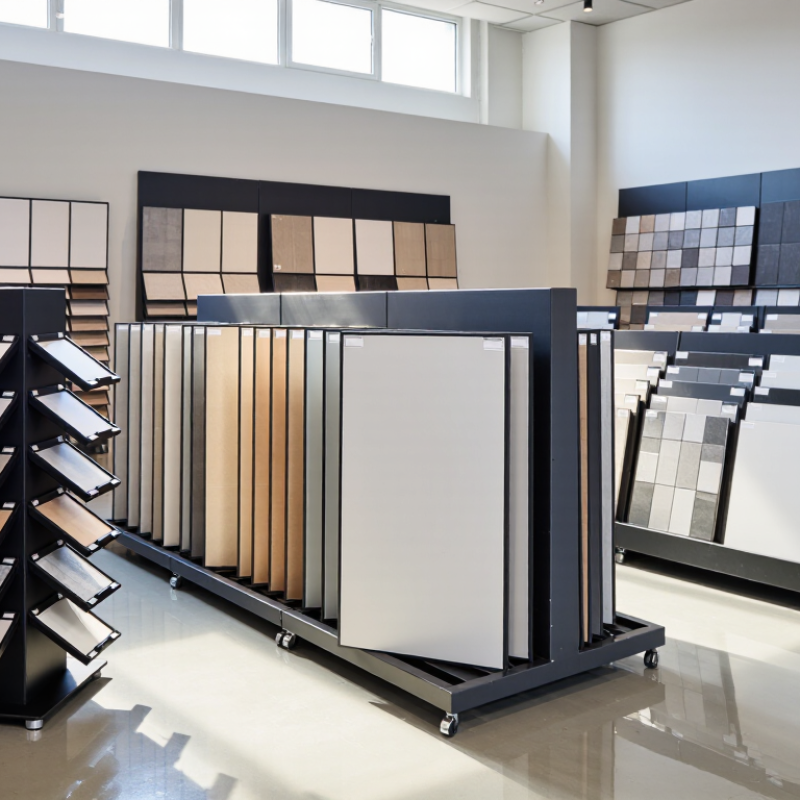
Tile display racks help customers compare materials without opening cartons or handling loose pieces. In retail stores, staff use vertical panels to show color, texture, finish, and grout combinations at eye level. Pull-out panels save floor space while letting shoppers inspect larger samples. That matters. A small label beside each tile can show its size, surface type, and recommended room setting, reducing repeated questions and confusion.
In showrooms, rotating or sliding racks make it easier to compare several styles under the same lighting. Staff can group samples by tone, format, or application, then guide visitors toward a practical choice. Keep frequently requested tiles within easy reach, and leave enough clearance for panels to move safely. Dust and fingerprints are easy to miss, but they can change how a surface appears. A rack can also feel crowded. Too many samples may slow decisions, so teams should review the display regularly and remove outdated or damaged pieces. Even a tidy rack cannot reproduce every home’s lighting, so customers may still need to view a sample in its intended space.
How to Evaluate China’s Tile Display Rack Suppliers
When comparing China’s tile display rack suppliers, look beyond polished catalog photos. Request technical drawings with rack dimensions, material thickness, weld locations, and shelf load ratings. Specific details matter. Confirm whether the quoted capacity applies to each shelf or the entire rack. Ask for current photos or a live video showing the base, wheel locks, and tiles in place.
A sample order can reveal more than a sales presentation. Check whether tiles sit securely, shelves remain level, and edges feel smooth after assembly. A neat sample may not reflect every production unit, so ask how the supplier checks finished racks and records defects. If possible, compare the sample with the approved drawing. Small mismatches can become costly in a large order.
Evaluate communication as carefully as construction. Clear replies about custom sizes, finish options, packaging, and lead times suggest a more dependable process. Ask how racks are protected against scratches and bent corners during shipping, and what documentation comes with the order. Compare quotations line by line; a low price may exclude useful features or stronger materials. No checklist guarantees a perfect supplier, and I would still inspect a production sample before committing.
Ten Notable Tile Display Rack Suppliers in China
China’s tile-display-rack suppliers serve showrooms that must present many finishes in limited floor space. Grand View Research estimated the global ceramic-tile market at USD 207.7 billion in 2023 and projected 6.2% annual growth from 2024 to 2030. That estimate describes tile demand, not rack sales, but it helps explain why flexible display equipment matters. A useful review of ten notable suppliers should compare more than price: check rack stability, sample capacity, finish quality, packing protection, and replacement-part support.
Look for suppliers offering distinct formats, including pull-out panel racks, rotating towers, wall-mounted boards, and displays built for large-format slabs. On a showroom visit, test whether a loaded panel slides smoothly and whether tile edges remain protected. Ask for drawings, load specifications, production lead times, and photos of completed installations. Details matter. A polished sample may not reflect bulk production, and export packaging can be an afterthought. Supplier claims are not independent verification; request a trial unit or inspect a recent shipment when practical. A ten-supplier comparison is most useful when it records these checks consistently, rather than treating “top” as a proven ranking.
How China’s Suppliers Compare in Products and Services
A useful comparison of China’s tile display rack suppliers starts with the products they can actually adapt. Some focus on compact countertop stands for small samples, while others build floor racks with pull-out panels, metal frames, and locking wheels. Check how securely a full-size tile sits when a panel is opened. Ask about finish options, sample capacity, and whether rack dimensions can fit your showroom layout. A polished catalog can still hide a weak hinge.
Service differences often appear after the first quotation. Compare drawing support, sample approval, packaging details, and how clearly a supplier explains production timing. For overseas orders, confirm crate measurements and request photos of protective packing before shipment. A quick reply is useful, but a precise reply is better. Ask who handles revisions if the delivered rack does not match the approved drawing.
Price alone tells little. A lower quote may exclude custom colors or stronger hardware, while a higher one may include features you do not need. Request comparable specifications from each supplier, then check welds, edge finishing, and moving parts on a sample unit. Even careful checks have limits; a single sample cannot guarantee every rack will be identical. The comparison should reflect real showroom use, not just attractive product photos.
How to Choose a Supplier for Your Tile Display Needs
Choosing a tile display rack supplier starts with your showroom’s actual needs, not a ranking alone. Measure the available floor space and note the sizes, weights, and finishes of the tiles you plan to display. A rack holding heavy stone samples needs different support from one designed for small ceramic pieces. Ask how shelves are secured and whether sample boards can be changed without tools.
Review material specifications, load limits, edge finishing, and corrosion protection, especially if racks will be moved often. Request drawings or a sample unit, then check for wobbling, sharp corners, and difficult-to-reach samples. Ask for proof. Clear answers matter more than polished sales language. Also confirm packaging, lead time, replacement-part availability, and how custom dimensions affect cost.
Compare suppliers using the same questions and specifications; otherwise, quotations can be hard to judge fairly. A custom layout may look excellent in a photo but feel awkward when customers handle the tiles. I would test one rack in a real display area before ordering many. That adds time, and I might still miss a detail, but it can reveal problems early. A dependable supplier should explain limitations plainly and provide practical drawings, written specifications, and a realistic delivery schedule.
Who Are the Top 10 Tile Display Rack Suppliers in China? - How to Choose a Supplier for Your Tile Display Needs
| No. | Supplier Evaluation Area | What to Compare | Evidence to Request | Why It Matters |
|---|---|---|---|---|
| 1 | Tile and sample compatibility | Supported tile formats, thicknesses, sample weights, and display orientations. | Dimension drawings, sample-fit checks, and a written compatibility list. | A rack must hold the intended samples securely and present them clearly. |
| 2 | Load capacity and stability | Rated load per shelf or holder, base stability, and resistance to tipping during normal use. | Load specifications, structural drawings, and test results for the proposed configuration. | Appropriate capacity and stability help reduce damage and safety risks. |
| 3 | Materials and finish | Frame material, surface treatment, edge finishing, and corrosion protection where relevant. | Material specifications, finish samples, and inspection criteria. | Material and finish affect durability, appearance, and suitability for the display environment. |
| 4 | Rack configuration | Available formats, such as panels, pull-out drawers, rotating displays, floor stands, or wall-mounted units. | Product drawings, photographs, and a configuration proposal for the intended showroom. | The right format depends on the tile range, floor space, and how customers browse samples. |
| 5 | Customization capability | Adjustable dimensions, colors, signage areas, sample labels, and branded or unbranded options. | Written scope of customization, drawings for approval, and a sample or prototype when needed. | Clear specifications help ensure the finished rack fits the space and display plan. |
| 6 | Manufacturing quality controls | Inspection steps for dimensions, welds, moving parts, finish quality, and packaging. | Quality-control checklist, inspection photos, and sample inspection records. | Documented checks make product consistency easier to assess before shipment. |
| 7 | Prototype and sample process | Availability of a pre-production sample, approval stages, and how revisions are handled. | Sample terms, approval drawings, and a record of agreed changes. | A sample can reveal fit, finish, and usability issues before a larger order is produced. |
| 8 | Order capacity and lead time | Production capacity for the requested quantity and the schedule for production and dispatch. | A dated production plan, order milestones, and written lead-time assumptions. | Capacity and schedule should match the installation or showroom opening date. |
| 9 | Packaging and shipping readiness | Protection for frames, glass or moving components, packing dimensions, and shipment options. | Packing specification, carton or crate details, and shipping terms for the destination. | Suitable packaging helps protect bulky display equipment during handling and transit. |
| 10 | After-sales support and documentation | Spare parts, assembly instructions, warranty terms, and response process for defects or missing components. | Written warranty and service terms, parts list, and assembly or maintenance instructions. | Clear support arrangements help address installation and service needs after delivery. |